The research
Task plans that survive damage.
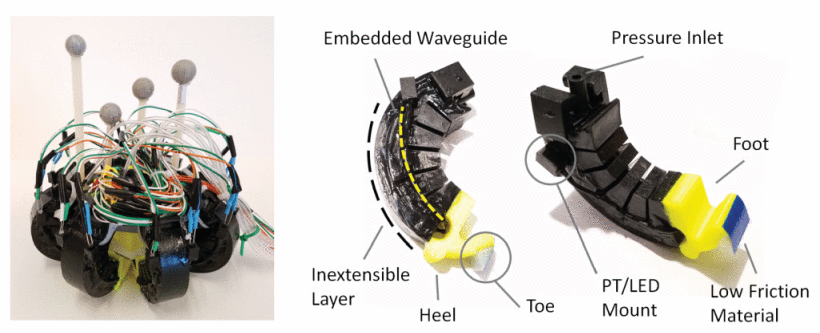
Soft robots use compliant actuators to move through and around obstacles in ways rigid, traditional robots cannot. However, that same flexibility can make their components more vulnerable to damage. This project used sensor-based controls to detect actuator failures, allowing a reactive soft robot to revise its plan and move to a location where the damaged actuator could be repaired or replaced.
For this project, I designed and fabricated the actuators and robots, and developed some sensor-based damage-detection elements. The work was published at the 2019 IEEE International Conference on Robotics and Automation (ICRA).
Field
Soft robotics
Focus
Damage-aware task planning
The approach
Letting the robot notice its own damage.
Traditional task planners assume a fixed, undamaged body. Here, sensor data collected from the actuators feeds directly into the planner: when a failure signature is detected, the robot replans its task around the damage rather than continuing to carry out a plan designed for the functional body that it no longer has.
What this enables
Robots that steer themselves to repair.
Once damage is detected, the robot attempts to steer itself to the nearest location where the damaged actuator can be repaired or swapped out.
In practice
Watching the robot recover.
These demonstrations show a reactive soft robot that senses actuator damage and replans its task in response.