The research
Propulsion by combustion and rapid expansion
Cephalopods propel themselves by rapidly expelling water from their flexible bodies. Inspired by this motion, this project sought to develop a combustion-powered hydro-jet engine that uses methane combustion to rapidly expand a silicone bladder, forcing water through a nozzle and propelling the robot forward.
The system demonstrated that combustion in soft, compliant structures can produce fast, repeatable underwater motion. Additionally, high-speed video was used to model the robot’s movement and the expelled water ring vortex that formed behind it.
Actuation
Combustion-driven
Propulsion
Underwater hydro-jet
Publication
Extreme Mechanics Letters · 2018
The propulsion system
Combustion creates motion
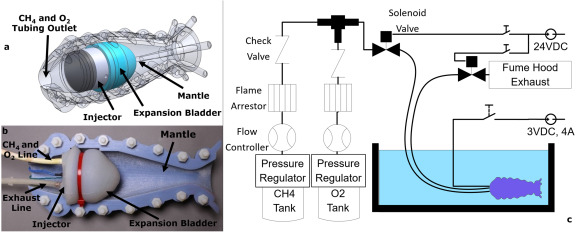
Once the assembly is submerged, the 3D printed body is filled with methane gas in a region behind the flexible silicone chamber. Once the methane is ignited, combustion occurs and deforms the silicone chamber, expelling water through the nozzle and producing the jet that propels the robot.
What this enables
Exoplanet exploration
A driving force behind this research was the ability to use this technology to explore regions where access to fuel sources may be limited, such as subaquatic environments on exobodies like Europa. In environments like these, it could potentially be feasible to electrolyze water to generate the necessary fuel for propulsion.
In practice
Fig. 01 / Robot body
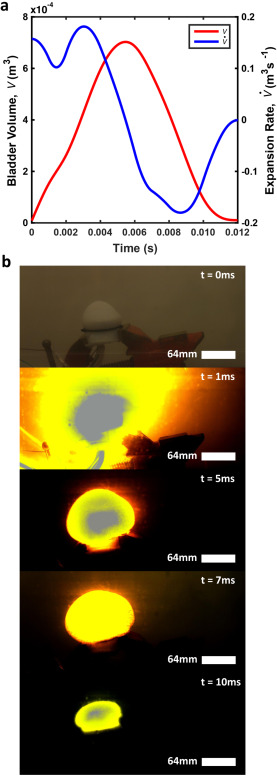 Fig. 02 / Bladder Expansion
Designing the compliant body.
These figures show the robotic assembly and gas combustion system as well as high speed images of the silicone bladder expanding in open air after a combustion cycle.